Kobel's Art Weekly 40 2026
The Armory Show has been refining its profile for years in order to remain New York’s leading art fair. Daniel Cassady and Brian Boucher describe the process in Artnews: “And despite all the changes, the Armory continues to fulfil one function remarkably well: it signals to New York that summer is over (or, as cliché lovers call it, ‘Back to School’). This role was particularly evident this year. When the fair moved to the Javits Centre in 2021, it was also rescheduled to the week immediately following Labor Day, placing it right in the midst of the flurry of gallery openings, dinners and parties that herald the autumn season. By moving the dates to 24–27 September, Frieze’s organisers also created some breathing space from its parallel fair in Seoul. The result felt, at least on the opening day, considerably more civilised. Rather than adding yet another major event to the already packed September calendar, the fair actually felt like the start of something new. [...] The more interesting question, however, is where The Armory fits into an increasingly crowded hierarchy of art fairs. This year’s edition brings together around 230 galleries – roughly the same number as last year – but a significant portion of the fair is dedicated to younger dealers and solo presentations.”
Max Lakin offers a somewhat more reserved description of ‘Independent 20th Century’ for the New York Times: ‘The Independent is more understated than its rivals. Since 2010, it has set itself the goal of presenting a less intimidating, more curatorially oriented fair, and keeps its exhibitor list (relatively) small. This year’s realisation of its 20th-century concept in the Breuer Building is a masterstroke that veils its undisguised ambitions with architectural heritage. (The Armory Show, by contrast, takes place at the Javits Convention Centre, home to Comic Con and the Greater New York Dental Meeting.) Elizabeth Dee, founder and director of the Independent, says her new home in the Breuer Building will be “permanent” – which, given the high turnover of tenants over the past 12 years, perhaps seems a little optimistic.”
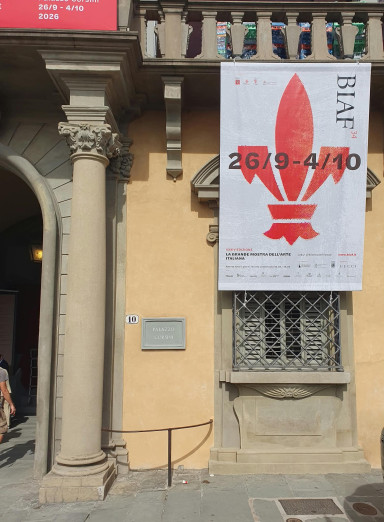
Italy’s rather strict export regulations are both a curse and a blessing for the Biennale Internazionale dell’Antiquariato di Firenze (Biaf), writes Gina Thomas in the FAZ of 26 September: “This lends the event – despite all the interest it attracts from foreign museum curators and collectors – a distinctly Italian character, which sets limits on its pursuit of internationality. Added to this, of course, is the occasionally rather eclectic presentation, in which exquisite pieces are mixed with more ordinary objects. [...] Under the new presidency of the Florentine dealer Bruno Botticelli, the fair is seeking closer ties with the city’s cultural institutions and the art market network in order to enhance its international standing. One example of this is the collaboration with the Palazzo Strozzi, which, under the direction of Arturo Galansino, has in recent years become a leading international exhibition venue. Fitting for a fair peppered with fragments in a fragmented age, the fascinating exhibition “Broken” has just opened there. Here, the international ambition is fulfilled with verve.” I was in Florence for the Handelsblatt of 25 September and Artmagazine.
Emil Sennewald visited Fine Art Paris the week before for the Handelsblatt of 25 September: “Since it was moved from November to September, the ‘Fine Art Paris’ fair has become, for many, an ideal, lavish start to the Parisian art autumn. ‘Above all, this is a French event, which is precisely why the international audience wants to be there,’ says Nicolas Andrin, whose gallery, Aborigène, is attracting a great deal of attention. After attracting 30,000 visitors in 2024 and 28,000 last year, the fair is at a turning point: quality and coherence have been noticeably strengthened; many dealers are confident following good sales last year; and initial doubts about the new format seem to have evaporated.”
‘The setting is breathtaking, the art so-so’ – that is how Ernst Herb describes the current edition of Contemporary Istanbul for the FAZ (currently accessible again without a paywall): ‘On closer inspection, however, it becomes apparent at the fair that the decorative element predominates in the works exhibited in the halls of an old shipyard. To top it all off, there’s celebrity art by Hollywood actor Johnny Depp, who is presenting a large-scale sculpture here for the first time. […] None of this detracts from the venue where CI is held; on the contrary. With its harbour facilities built 2,700 years ago by Greek colonists and the view of the Hagia Sophia, the exhibition site outshines all its competitors’ venues worldwide, be it Art Basel Paris in its breathtaking glass palace or Art Basel Hong Kong with its view of the spectacular skyline. Even though Istanbul scores highly for its infrastructure, the quality of the art on display is, on the whole, lacking.”
Vanessa H. Larson reports for The Art Newspaper (maybe paywalled) on Artbo in Bogotá, which continues to have a regional character.
Following recent rumours about TEFAF’s departure from Maastricht, the dealers’ organisation is now taking decisive action and, according to a press release, has secured a long-term commitment: “The extension consolidates the long-standing partnership between TEFAF and the MECC Maastricht and secures the fair’s venue until 2036. The new agreement follows on from the current contract, which runs until the 2027 edition. [...] A new five-year contract secures TEFAF New York’s venue at the Park Avenue Armory until 2031.”
Brita Sachs asks in the FAZ whether the Scheublein auction house in Munich can step into the gap left by the announced closure of Neumeister: “It is no coincidence that the profiles of the two multi-disciplinary firms are similar; after all, Michael Scheublein worked for almost 25 years – nine of them as managing director – in the company run by his father-in-law, Rudolf Neumeister. When disagreements arose with his daughter Katrin Stoll, Scheublein and his wife Martina Neumeister-Scheublein promptly founded their own auction firm in 2008; the couple now shares the management of the business with their daughter Nikola.”
Expensive art is not necessarily good, and good art is not necessarily expensive. Alex Greenberger puts the first part of this aphorism to the test for Artnews: “Mega-galleries are now signing artists who aren’t even 30 yet, and putting them on a stage that used to be reserved for the established, the well-known and those who have proven themselves on the market. And so, when discussing these rising stars, the talk is of dollar signs and auction records. The work itself is rarely discussed. How good is all this art actually? Six gallery exhibitions in New York – all solo shows for artists under 45 with auction records of nearly 200,000 dollars or more – offer the opportunity to make this assessment. With the exception of one of these exhibitions, the picture isn’t exactly a pretty one.’ The result is both refreshing and sobering.
Last week’s threat by the current Minister of State for Culture, reported by dpa, to make federal cultural funding contingent on the right political views sets a precedent that a potential successor from a less democratically minded party could build upon. The idea is not met with universal approval, however. Saskia Trebing, for example, is not impressed in Monopol: “The most recent case comes from the independent Minister of State for Culture, Wolfram Weimer, who, since taking office, has presented himself more as a cultural warrior than as a cultural enabler. Should The Left join the government in Berlin – the party, with its lead candidate Elif Eralp, emerged as the clear winner in last Sunday’s election there – Weimer intends to reconsider the federal funding for culture in the capital that has just been approved. […] Whether Weimer could actually put his public musings into practice at all (the capital funding agreement, which runs until 2037, has already been signed) is one question. But the mere impression that funding is only available if the political orientation is right is disastrous. Not only does it run counter to the constitutionally guaranteed freedom of the arts, but it also undermines the conviction that has taken root in Germany since the 1970s that a culture which can flourish freely with state support ultimately benefits everyone.”
Victims of Nazi persecution and their heirs may find renewed hope in the US, reports Frauke Steffens in the FAZ ahead of two upcoming court cases: “Two new lawsuits could change the way Nazi-looted art is dealt with in the United States. As the ‘Los Angeles Times’ reports, both cases are looking more promising thanks to legislative changes in California and at the US federal level. In future, measures are to be put in place to prevent restitution claims from failing solely due to the statute of limitations or other legal hurdles. The two new lawsuits differ greatly in substance; only one falls under the conventional definition of looted art or forced sale.”
Katharina Cichosch announces a new series on outsider art at Monopol: “One thing is certain: in many respects, these ‘outsiders’ have long since become insiders. They exhibit in institutions and galleries, are collected by both public and private collectors, and have their own magazines and art fairs. Take the Outsider Art Fair in New York, which has been held every year at the Metropolitan Pavilion since 1993. In 2013, another branch was established in Paris. […] No wonder that ‘New York Magazine’ critic Jerry Saltz is also raving about the Outsider Art Fair. Incidentally, this is also because what is exhibited and available here is precisely what is currently disappearing – or has already disappeared – in many places: the mid-market, that is, art in the mid-price range, which used to be a sweet spot for dealers, artists and buyers. That said, there were also entry-level prices, without one ever feeling, even for a second, as though one were looking at the usual offerings for precisely such ‘entry-level art’.”