

Stephan
Zilkens
,
Zilkens' News Blog 42 2026 - the last one with authorized English translation
The world is changing. This also applies to translation programmes that help us with our day-to-day tasks. We use DeepL – which is only natural for a Cologne-based company, as it is one of the few German ‘unicorns’ and the translation quality is very good. Many browsers also offer translation features – and we believe that those interested in our information and in Kobel’s Art Week in other languages can make use of these translation tools. This is therefore the final edition of our news blog and of Kobel’s Art Week to be published simultaneously in English.
A Manchester-based commercial law firm has examined the potential consequences for the art insurance market arising from the increasing number of thefts in museums. The study published by the DWFGroup is entitled ‘Reputation is not a security system’. Even though stolen works are sometimes recovered quickly by a stroke of luck – such as the Renoirs recently stolen from Cagne-sur-Mer – it is essential to address the changing risk landscape. This applies just as much to the institutions that support the museums as it does to the insurance industry, which usually covers these risks for a modest premium. Here, the principle still holds true for public institutions issuing tenders: nothing is more cost-effective in risk management than cheap insurance. However, their underwriters (obviously of all genders, of course) must ask themselves whether, despite competition, they have taken sufficient account of the risk situation. Which insurer still sends its own staff to set up a complex and fragile exhibition, as Nordstern Versicherungen did in the 1980s? Sometimes the presence of too much press can distract staff during the set-up, leading to a risk of handling errors. The museum management needs the positive press coverage and does not intervene. The insurer could halt the set-up and order the press to leave the premises. This happens just as rarely today as the requirement that only haulage companies with well-trained staff – trained in handling art and equipped with the appropriate logistical equipment – should carry out art transport. The ARTIM companies or ICEFAT members should be mandated. If the council’s vehicle fleet were then to carry out the transport, one might assume there would be no cover. But even here, many insurers lack the courage.
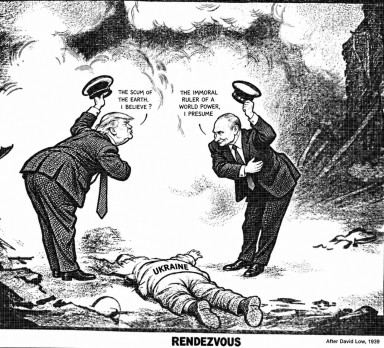
Trump does as he pleases – moral or ethical guidelines are a foreign concept to him. The indirect increase in his family’s wealth is more likely to be a driving force. After all, his son-in-law is very often involved when it comes to diplomatic negotiations. The latest US aid to Ukraine was also only provided in return for assurances that the US would be allowed to help itself to the country’s raw materials once the war was over. Now, the military action against Iran has driven up energy prices in the US as well, which could cost votes in the mid-term elections. So they’re now hastily lifting sanctions against Russia and importing diesel from there, which automatically improves Russia’s trade balance and pushes the prospect of an early end to the war even further into the distance. Now Zelenskyy is even adhering to his country’s constitution – that, too, annoys Trump, and that is why the Ukrainian President ought to be replaced. With Trump as President, the US has squandered any moral claim to leadership for a tolerant, Western-style society. We can be glad that the Nobel Peace Prize was awarded this time to a woman who has rendered outstanding services to international criminal justice.
Back to art – like so many cities, Cologne now has only one local daily newspaper, which frequently exploits its position as an opinion-shaper in rather peculiar ways. After all, there is no longer any competition. A whole page has now been devoted to the notorious and convicted art forger Beltracchi, including a commentary suggesting that the man should be given a chance because he has served his sentence. It is bad enough that actors such as Christoph Waltz have, for the sake of television ratings, associated with him following his conviction – according to his own account, Beltracchi still knows of over 400 works in public collections that are said to have been created by him and not by the artists credited to them. As long as he does not name these 400 works, I see no reason to give this forger another chance.
There are many collectables that are collected around the world. Despite mobile phone cameras offering increasingly better quality, mechanical cameras are still being produced, collected and sometimes auctioned. This was the case last Saturday in Wetzlar, where K.A. Hoffman and Henrik Hanstein, amongst others, were able to auction a 1923 ‘Ur-Leica’ for 4,250,000 EUR. The estimate was 600,000 EUR. It will now be interesting to see whether the buyer commissions a specialist freight forwarder or one of the usual parcel delivery services to transport it to the USA.
Enjoy the rest of Kobel’s Art Week and make the most of the week ahead
Stephan Zilkens and the team at Zilkens Fine Art Insurance Broker GmbH in Solothurn and Cologne
automatically translated