
Stefan Kobel
,
Kobel's Art Weekly 11 2026
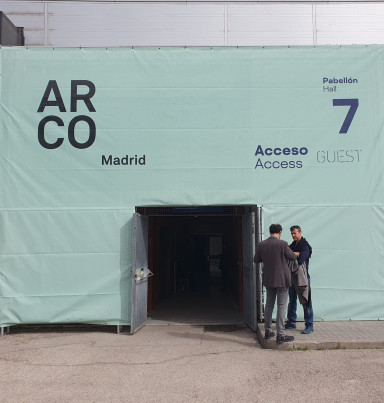
Sarah Belmont explores possible reasons for Arco's somewhat sluggish opening for Artnews: "Some mentioned a competing breakfast event that may have diverted VIP attention. Others speculated whether the current geopolitical climate had prevented the attendance of collectors from the Gulf. But Arco has always followed its own tempo, and by noon, the aisles were teeming with visitors. ‘We haven't sold much yet, but I believe that in the coming days we'll reap the rewards,’ Chantal Crousel, founder of an eponymous Paris gallery, told ARTnews. "It's a slightly slower fair. There’s a great deal to see, and people really take their time looking. When they experience an initial spark, they tend to step back and verify it first.” Nicole Scheyerer discusses the close relationship with institutions at Parnass: “Engaging with one’s own roots – whether ethnic, cultural or artistic – remains a constant at ARCO. Identity continues to be a leitmotif. The fact that many galleries are showing photographic works by queer artists this year is partly due to the reorganisation of the collection at the Reina Sofia Museum, which has dedicated separate chapters to the subcultures of the 1980s and the AIDS crisis.” Towards the end of his tenure at the FAZ (paywall), arts editor Paul Ingendaay is allowed to travel once more to his old stomping ground in Madrid and criticise the art fair there in the words of his Spanish colleagues: "ARCO is opening up to young galleries through curated collective exhibitions, she [ARCO director Maribel López] said in an interview with journalists, maintaining its connection to the important Latin American market and relying on its proven format in its 45th year of existence. To some, however, this seems too little in this small anniversary year. The culture supplement of the newspaper “ABC” sees Art Basel and Frieze in London as winners of globalisation, because these fairs have conquered new markets in Asia and the Gulf region, while ARCO is becoming regionalised, which simply means dwarfing. In this sense, the ARCO offshoot in Lisbon, founded in 2016, is more of the same: art in the Iberian corner of the world. However, according to the critics, wealthy collectors from Latin America in particular have long had a better, more accessible showcase in Miami, where Art Basel expanded in 2002, not to mention Hong Kong in 2013. ARCO, ABC concludes, has lost the global race. The reputation-damaging distortions of the Spanish media are so false that not even the opposite is true. It remains a mystery why the otherwise thoughtful author has adopted this nonsense. I was in Madrid for Artmagazine and the Handelsblatt on 6 March.
Arun Khakar has compiled sales successes from Frieze Los Angeles for Artsy.
In a detailed essay for the Observer, Paco Barragán tells the story of the global art fair wars: "Where Art Basel has operated as a geopolitical architect—selecting, occupying and consolidating the world's most decisive cultural nodes—Frieze has expanded largely through replication, embedding itself in places where the ecosystem was already formed. The majority of fairs worldwide, from Europe to Asia and from Latin America to the Gulf, remain locked in regional circuits. They do not scale, they do not reorganise flows of capital or legitimacy, and they do not alter the global map. Only Art Basel does that; Frieze follows its contours rather than redrawing them. As of today, the truth about the global art fair wars is simple: Art Basel changes cities; Frieze joins them. The rest observe from the regional margins.‘ Absolutely worth reading!
Scott Reyburn analyses the challenges facing TEFAF in the New York Times (paywall may apply): ’Now that rival prestige shows such as the Paris Biennale and London's Masterpiece have closed, it is the last remaining of Europe's grand old art and antiques fairs. [...] The booths are filled with art and objects that seem to make time itself stand still. But outside the fair walls, much has changed in the art world — and the wider world — over the last four decades. This presents TEFAF with challenges. European old masters, the fair's core speciality, have fallen out of fashion with most wealthy collectors. In 2024, just 3 per cent of the world's art dealers specialised in old masters, compared with 65 per cent who traded in contemporary and post-war works.
The London auctions went surprisingly well, Elisa Carollo analyses for the Observer: "If the £131 million total achieved at Sotheby's the previous evening suggested that the art market continues to move forward with remarkable composure—seemingly unfazed by wars, political fractures and a global economy unravelling in slow motion—Christie's set out to reinforce the point yesterday (5 March) with its three-session marquee evening sale. The proceedings unfolded largely without drama, following what often felt like a carefully prearranged script, ultimately delivering the auction house a combined total of £197,472,600 ($263,823,394). Across the three sales, 21 lots carried third-party guarantees securing their results—a 52 percent year-over-year rise.”
As the art market becomes increasingly part of the luxury goods industry, it is worth taking a look at the trends there, believes Elisa Carollo of the Observer: "Luxury industry reports now provide a crucial barometer of where the art market may be headed, particularly as recent surveys rank art as the worst-performing personal luxury good. That finding alone suggests the art market still has meaningful ground to cover in responding to behavioural shifts among HNW individuals that adjacent industries have already begun to navigate." Who would have thought that art could perform modestly when placed on the shelf alongside handbags and trainers?!
I describe the activities of the major auction houses in the Gulf region for Monopol (paywall): "In Dubai, traditionally the most finance-friendly emirate, Christie's held its first auction 20 years ago. Bonhams has had a branch there since 2007 and Sotheby's since 2017. Sotheby's has been present in Abu Dhabi since last year. Most of these are showrooms. Qatar will have to make do with one for the time being. Only the next few years will tell whether the art market, which is currently being established there by Art Basel Top Down, will actually prove viable."
Wolfram Weimer is increasingly turning out to be a free-swinging wrecking ball in the German cultural landscape. In Der Spiegel (paywall), Hannah Pilarczyk puts it bluntly: ‘After just under a year in office, he has no notable policy achievements to his name. This probably doesn't even bother him, because as has become clear in recent days, he is pursuing an agenda that has nothing to do with the coalition agreement: he is pushing for a break with the federal government's previous cultural policy.’ The Tagesspiegel (with agency material) addresses inconsistencies in Weimer's approach: "A spokesperson for the BKM has now confirmed to the F.A.Z. that the authority did not make use of the option provided for in the Haber procedure to request clarification from the Office for the Protection of the Constitution. Weimer had previously defended himself against criticism of his decision. “In times of high polarisation, extremism must be combated – not encouraged,” the politician told the German Press Agency on Thursday. “Prizes financed by taxpayers” money should only go to institutions that are above suspicion.' When asked, Weimer and his agency did not want to reveal exactly what the three bookshops were accused of. “The exact nature of these findings is subject to secrecy,” said a BKM spokesperson.‘ Patrick Bahners researched the allegedly applied ’Haber procedure" and the BKM's almost complete ignorance of its application for the FAZ (paywall): “In 2017, the BMI stated that enquiries should only be made about organisations and individuals 'who are unknown (e.g. because they have not yet appeared in public) or whose harmlessness cannot be deduced from the respective context”. This wording already raises the question of whether there was any intention to make enquiries about well-established bookshops at all.‘ Incidentally, the reason given by Weimer for refusing to provide any further information, citing ’confidentiality", is completely grotesque. That's pretty heavy artillery. The Federal Office for the Protection of the Constitution explains the term as follows: ‘The aim of secrecy protection is to protect information and processes whose disclosure could endanger or damage the security or interests of the federal government or the states from unauthorised access.’ However, according to Wikipedia, an older version of the authority's glossary still referred to ‘vital interests’. And all this fuss is about three small bookshops. Apparently, we don't necessarily need the AFD to undermine the rule of law. Our Minister of Culture can do that all by himself.
semi-automatically translated