
Stefan Kobel
,
Kobel's Art Weekly 15 2026
1 April is also a recurring opportunity for media literacy exercises. Monopol has Wolfram Weimer relocating documenta to Lake Tegernsee. In Artmagazine, VAT on art is being raised to 30 per cent. According to Hyperallergic, the Louvre is now getting door locks.
No April Fool’s joke is the dpa report of a hacker attack on the Uffizi in Florence. The data theft appears to be so serious, according to ongoing coverage by the Corriere della Sera (including here, here and here), that some objects have been moved to off-site storage and exits and windows have been bricked up, as all details of the security measures have also been compromised.
Sabine Spindler visited the Salzburg International Fine Art Fair (Sifaf), which was founded rather spontaneously to coincide with the Easter Festival, for the Handelsblatt on 3 April: “With 20 exhibitors, Sifaf is not a fair that seeks to compete with TEFAF in Maastricht or the Biennale in Paris. But it brings together Austria’s most dedicated art dealers. [...] Like its predecessor, Sifaf remains very Austrian in its concept; works by Joan Miró, Alfred Sisley, Alexander Calder or the Old Masters are nowhere to be found. Instead, the new fair surprises with its unusual location. Rather than passing by spacious booths, visitors move across five floors through corridors and small chambers, where paintings by Oscar Moll, Franz Grabmayr or Zoran Music hang side by side.” In the FAZ (paywall), Brita Sachs describes the adversities art fairs in Salzburg have to contend with: “It remains to be seen what the future holds for SIFAF. Will it stay at the Koller-Haus, or will it seek a larger venue? Is it still possible to return to the Residenz? Initially, the rejection there was justified by upcoming renovation work. When the funds for this fell through and the fair reapplied, the rejection was justified on the grounds of heritage protection. For decades, however, the heritage authorities had found nothing to criticise and should, in fact, trust people who deal with art on a daily basis to behave considerately in historic spaces.”
Carlie Porterfield visited a somewhat different art fair in California’s Mojave Desert for the Art Newspaper: “Could the future of art fairs look less like a white-walled convention centre and more like a dusty motel in the Old West? In the high desert of Southern California, the High Desert Art Fair (HDAF) made the case for an unorthodox art fair model last weekend. With lower costs and a novel location near Joshua Tree, the fair is part of a broader shift in the market as collectors and gallerists alike grow weary of riding the same art fair circuit and seek to attract new audiences.” We need many more unusual formats to re-establish art’s place in society. Even if one or two events seem a bit unconventional at first glance.
John P. Murphy describes how the New Deal used art as a tool of democracy in Artnews: “Imagine a world where an artist is considered an essential worker. The government commissions murals and sculptures for schools, libraries, and hospitals. Taxes fund free classes in pottery and printmaking at a community art centre. The President of the United States promotes art as vital to a healthy democracy. This world flickered into view between 1933 and 1943, a decade when the US government treated art as a public resource rather than a private luxury.
The output was staggering: hundreds of thousands of artworks—murals, paintings, sculptures, prints, and photographs—by then-unknown artists such as Willem de Kooning, Philip Guston, Lee Krasner, Jacob Lawrence, Alice Neel, Louise Nevelson, Isamu Noguchi, Jackson Pollock, and Mark Rothko. They were part of the era’s bold vision of cultural democracy: art by the people, for the people.”
Janika Gelinek, director of the Berlin Literaturhaus and a jury member of the Capital City Culture Fund, warns against Wolfram Weimer’s behaviour, which undermines democracy and damages reputations, in a guest article for ZEIT (paywall): “Wolfram Weimer is damaging the constitution he claims to protect, and that, incidentally, is anything but conservative. He is not promoting conservative cultural policy, but is undermining two cornerstones of our democracy with his various opaque procedures: artistic freedom and the right to freedom of expression. Even though he claims to protect these rights publicly, mechanisms of self-censorship automatically arise: what can one still say publicly, and what should one say from a tactical perspective? And that’s without even mentioning his behaviour, which damages Germany’s reputation as a cultural hub abroad.”
Art as a store of value and an instrument in wealth transfer is currently the driving force behind the auction scene, believes Scott Reyburn in the Art Newspaper (possibly behind a paywall): “This institutional interest is presumably encouraged by an awareness that, during the so-called Great Wealth Transfer, 1.2 million individuals will pass on around $31 trillion of assets to their heirs over the next decade. Just over 10% of the value of those assets will be made up of art and collectables, the Deloitte report estimates. This process is the main driver of whatever growth there is in the art auction market. [...] If London’s March auctions were anything to go by, the world’s ultra-rich will not be too bothered in New York in May if war is being waged in the Middle East or elsewhere. Desirable works by trophy names such as Pollock, Picasso, Brâncuși and Rothko will fetch huge prices. But if more and more money is invested in the relatively safe bet of blue-chip 20th-century art, and more and more buying is influenced by AI-driven assessments of financial risk, where will that leave the art of today? After all, isn’t good art meant to be about risk?”
The sale of a dinosaur skeleton via a purely online platform for $5.5 million illustrates a trend, believes Daniel Cassady at Artnews: “Fossils are now catalogued, marketed, and staged like sculpture. Condition reports emphasise completeness and restoration. Provenance files are treated like those of a painting. The language has shifted, and with it the audience. Joopiter’s role is telling. The platform, launched in 2022, has built its identity on design, fashion, and cultural ephemera. [...] The direction, though, is clear. A $5.5 million triceratops sold online is not a stunt—it is what a mid-market transaction looks like once a category has been fully absorbed into the auction ecosystem. The headline numbers may belong to Sotheby’s and Christie’s, but the next phase of the market is being tested elsewhere.” He is probably right.
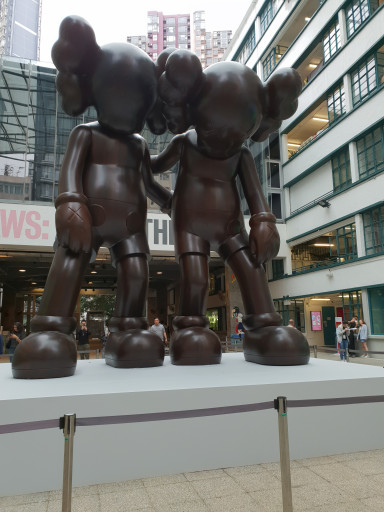
Even after the Schröder era, the Albertina remains true to its market-oriented course. Now it is providing a stage for KAWS, reports Katharina Rustler in the Standard: “Of course, one can view it critically, or at least smile wryly, that someone like this is moving into a renowned museum. That is probably why a well-founded, theoretical contextualisation of this position was so important to Albertina Director General Ralph Gleis. This lends weight to this atypical solo exhibition and justifies it within a classical museum. It is actually a clever marketing move that could potentially appeal to a new audience, very much in line with Gleis’s intentions. After all, KAWS is already a household name, particularly among young people.” According to Eileen Kinsella at Artnet, the San Francisco Museum of Art shows how to take things a step further: “The San Francisco Museum of Modern Art is currently hosting a survey of the artist’s work—the final stop on a three-museum tour—that offers evidence of his business acumen, presenting a portrait of an artist intent on building a diversified operation whilst making shrewd moves to bolster his artistic credibility. As part of the exhibition, the artist, whose real name is Brian Donnelly, designed 1,000 KAWS-branded memberships priced at $300 each, which included a complimentary KAWS figure and limited-edition KAWS cards. [...] Museums are hungry for that enormous audience, but KAWS also benefits from institutional approval, which can help with the complicated task of sustaining an artist’s market over the long term.“ However, the SFMOMA is almost entirely privately funded. If the Albertina is already aligning itself with American conventions in its exhibition policy, it should also be prepared to face questions as to why the state should continue to subsidise it.
Regarding the closure of the Munich auction house Neumeister, which was reported here last Monday, Brita Sachs notes in the FAZ (paywall): “Katrin Stoll earned great merit through her commitment to provenance research, particularly in coming to terms with her own firm’s history regarding its predecessor, Weinmüller, during the Nazi era. In the art trade, she earned admiration for this, but also caused unease, presumably because some feared she was stirring up trouble. Contrary to observers’ expectations, few followed her good example. The summer auction on 24 June will still take place as planned at Neumeister.”
Lee Cheshire and Elena Goukassian have compiled and interpreted the annual ranking of the world’s 100 most-visited museums for the Art Newspaper (possibly behind a paywall): “Our annual survey shows that some of the world’s most venerable institutions are still struggling to attract the number of visitors they had before Covid, but there is enthusiasm for new museums, and in regions such as Asia and Latin America”. No German institution features in the list. Bernhard Schulz has analysed the figures for Monopol. The table itself is available to download without a paywall.
In the US, a court has ordered art dealer David Nahmad to return a painting looted by the Nazis, writes Graham Bowley in the New York Times (possibly behind a paywall): “In ruling against the art dealer and billionaire David Nahmad and the Nahmad holding company, Judge Cohen said the defendants had ‘failed to raise any material issues of fact, and offer no evidence that identifies anyone other than Mr Stettiner as the owner of the painting or that he voluntarily relinquished it’.” Mr Stettiner, a Jewish dealer of British nationality, died in France in 1948, according to documents submitted to the court. The decision marks a victory in a long campaign by Mr Stettiner’s grandson, Philippe Maestracci, and a company, Mondex, which specialises in recovering looted art. They began working to reclaim the painting, once estimated to be worth as much as $25 million, years before filing the lawsuit.”
The Berlin artist Sven Vollbrecht would like to hand over the domain gallery-weekend-berlin.com to Gallery Weekend Berlin free of charge, but this appears to be proving difficult. On Facebook, the artist explains his initiative: ““I don’t want money. I want the institution to recognise the value of its digital identity,” says Vollbrecht […]. He demands that the management accept it in person on 1 May 2026. The recent involvement of a lawyer as a mediator marks a strategic turning point in the dispute, yet Vollbrecht remains unimpressed. He is deliberately exploiting the legal grey area of domain ownership to reverse the balance of power between artist and institution. Anyone wishing to find Gallery Weekend online must accept his terms.” Gifts, however, are characterised by the fact that they are not tied to any consideration. Otherwise, it amounts to some form of (barter) transaction or blackmail.
There is now also a direct link to the episode of Johann König’s podcast Was mit Kunst, in which he talks to me about the art market.
semi-automatically translated